A solo developer from Latvia sent me two Max for Live devices. I put them on one channel, pressed play, and the track more or less wrote itself. That is the short version. The longer version is what this post is about, because these two devices solved a problem I did not even know I had.
Meet Ian and ijo audio
The person behind these devices is Ian, working under the name ijo audio. We have been in touch over email for a while, and you can feel when someone actually cares about what they are building. Thoughtful replies, new ideas every week, zero hype. That is the main reason I wanted to put these devices on the channel. When a solo developer ships something this good, people should know about it.
The two devices are called Augur and Celestine. Augur is a generative MIDI sequencer. Celestine is a real-time granular processor. On their own they are already strong. Stacked on one channel, they become a living system.
Augur: A Turing Machine That Mutates Its Own Modulation
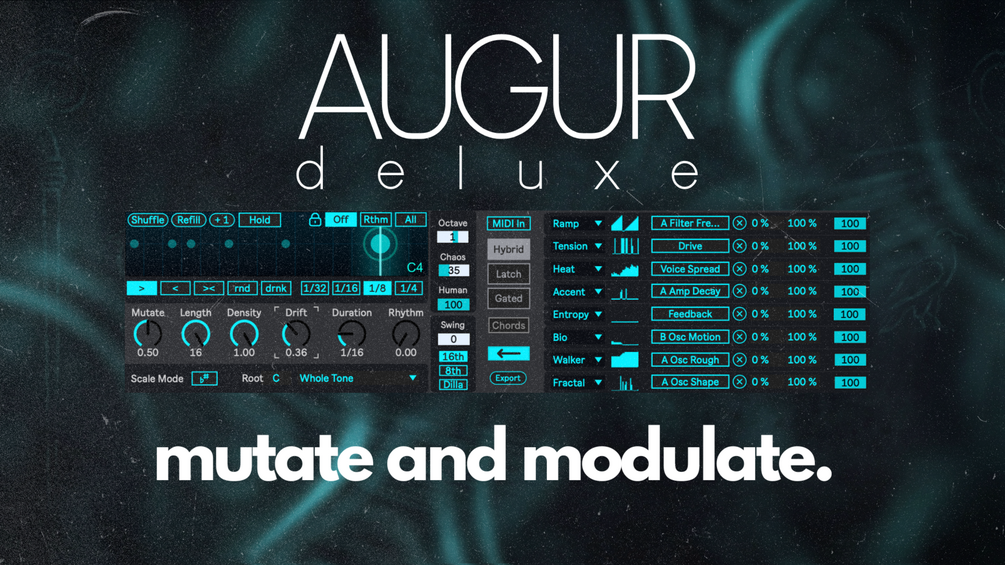
If you know the Turing Machine from Eurorack, you know the concept. It was one of those modules I always wanted but never got, because back in the day you had to solder the kit yourself and I was not ready for that. Today I would probably do it, but now I do not have to.
The core idea is the mutate knob. At zero percent the sequence loops cleanly. At the other extreme it drifts into pure randomness. The musical sweet spot sits somewhere in between, where the phrase repeats like a loop should, but a few notes shift each time. Around 50 percent you get motifs that feel intentional without ever being identical.
Density is the other control I reach for. Instead of randomly muting notes for a breakdown, it acts as a threshold. Lower it and the weakest notes die off first, leaving a sparse pulse. Raise it back up and the exact same notes return. That is a very different feeling from pencil-drawing a breakdown in the clip view.
That part alone would already be a solid sequencer. The thing that makes Augur special is the modulation section underneath.
Normally when you patch an LFO to a parameter, the modulation runs on the clock, independent of what the sequence is doing. Augur does it differently. It gives you an 8-lane modulation matrix where each lane is driven by actual properties of the pattern you are playing. Heat rises when the pattern gets dense and drops when it opens up. Tension rises the further a note sits from the root of your scale, which is perfect for driving a wavefolder or distortion. Entropy slowly climbs while the loop is locked and resets to zero the moment you mutate it.
There are five more algorithms on top of those: Ramp, Accent, Bio, Walker, and Fractal. Walker is the one I reach for most, it behaves like an unstable LFO that you can map to almost anything. The rest turn the math of your melody into wandering, organic textures.
The point is not that I have a lot of controls. The point is that I know I can randomise most of it and still trust the output. That is a very different feeling from drawing notes by hand.
Celestine: Granular Without the Sample Load
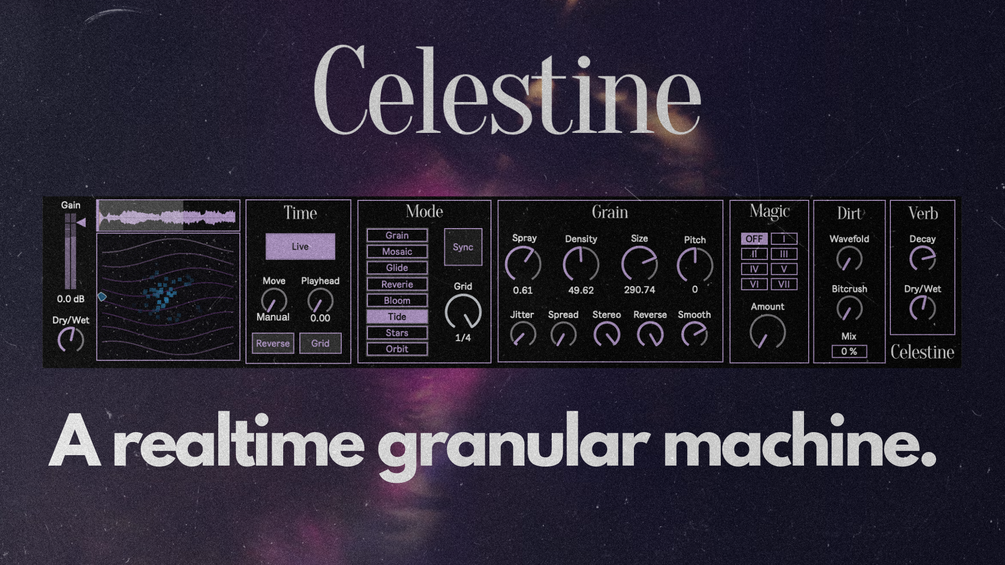
Celestine is a real-time granular engine. No sample loading, no file browser. It hosts a rolling buffer that listens to whatever is coming in on the channel and breaks it into grains on the fly. Think of it as a live S-4 style processor inside your DAW. The feeling Ian was going for is closer to a boutique guitar pedal than a clinical granular plugin, and you can hear it. It behaves like something with a personality.
You get the usual controls: grain size, density, spray, flux. Crank the wet to 100 percent and you hear exactly what the engine is doing to the signal. Mix it 50/50 and it sits on top of the dry source as a texture layer. That second mode is how I use it.
What is different from other granular tools is the eight engines. Grain is the classic mode I stayed on for most of the session. Mosaic pitches grains into harmonic clusters. Glide bends them. Reverie does dreamy reverse washes. Bloom makes ghost-echo reflections. Tide adds amplitude waves. Constellate locks grains to the grid. Orbit sends them on circular spatial paths. Each one is a different personality for the same source material.
Celestine also ships with a built-in effects rack: bit crush, wave folder, reverb, and a Magic panel with seven tone-shaping algorithms. I turned the Magic presets off because I wanted to place my own effects after it, but the reverb is genuinely nice and saves a slot on the chain.
The System on One Channel
Here is the chain I used in the video:
- Augur generates the notes
- Expressive Chords turns each note into a chord
- Operator as the voice
- Celestine processes the audio output, 50 percent wet
- Auto Filter for slow frequency bending
- A touch of Fibre reverb
That is the whole voice. One synth, two devices from Ian, a filter, a reverb. Because Augur is mutating both the notes and the modulation on Operator, the sound never settles. Because Celestine is running live on the output, every grain it catches is slightly different from the last one. The two layers feed each other and the track ends up somewhere between stable melody and dreamy instability.
I added a second channel with a bass line using the same Operator and Augur combination, but without mutation on the bass so it stays grounded. A backyard field recording sits underneath with Valhalla Supermassive for the background space. The rest is just mixing.
Why This Matters
I make Hypnotic Techno and ambient. What I always want is motion that feels organic, not grid-snapped. Live granular processing has been my answer to that for a long time, which is why I play the Torso S-4 on most of my tracks. A Turing-machine-style sequencer with mutating modulation was the missing piece I did not know I was looking for. Now I have both, in the box, on one channel.
If you are into ambient, generative music, drone, or anything where the performance matters more than the arrangement, these two devices will click immediately. If you are writing tight dance floor material with fixed arrangements, this is probably not your tool. Know what you need.
Ian also runs a YouTube channel where he goes deep into every knob of both devices. I highly recommend watching those walkthroughs if you decide to pick them up. He explains the design thinking, not just the parameters.
Try Them
Both devices are $19 on Gumroad, with free lifetime updates. The links below are affiliate links, so every purchase through them supports both Ian and the channel.
- Augur (generative MIDI sequencer): gumroad.com/a/180810643/prbdhy
- Celestine (real-time granular): gumroad.com/a/180810643/swjui
Grab them, put them on one channel, and see what happens. That is the whole pitch.
If you enjoyed this, check out Exploring the Torso S-4 for more on live granular processing, and The Liquid Modulation Matrix for another take on organic modulation.