Finding the Sequencer That Speaks My Language
When you walk into Superbooth, you're not just entering another music tech convention - you're stepping into a living, breathing ecosystem of electronic music culture. Unlike the sterile conference halls of NAMM or Musikmesse, Superbooth transforms Berlin's FEZ center into something that feels more like a festival than a trade show, with performances, workshops, and collaborative spaces scattered throughout the wooded grounds.
This year marked a special milestone for me - my first time attending as a creator rather than just a participant. The energy was different when you're showing up with a purpose beyond just drooling over gear.
The Festival Atmosphere That Makes Superbooth Unique
Superbooth has a vibe that's hard to describe if you've never been. Picture this: tucked away in a wooded area of Berlin, you've got major brands showcasing their latest synths alongside tiny boutique manufacturers who've 3D-printed experimental prototypes in their bedrooms. Live music fills the air everywhere you turn. It's not background music - it's the whole point.
One moment you're watching a serious tech demo, the next you're part of an impromptu jam session on a rooftop as the sun sets over Berlin. Someone's running a tracker on a Steam Deck to sequence a massive modular system (seriously, one of the coolest hacks I saw all weekend). That's Superbooth in a nutshell - the unexpected nestled comfortably alongside the cutting-edge.
The Human Connection
The most meaningful part wasn't the gear, though. It was finally meeting Miles from our "Signal Chain Stories" podcast in person after working together remotely for so long. It was bumping into other creators I've admired for some time and ending up in dance sessions that turned into friendships.
The YouTube creators meetup organized by BoBeats was particularly special. Standing in a circle with Alexander Spree, Underdog Electronic Music School, and dozens of other people who understand exactly what it means to create electronic music content - that's a feeling you can't replicate online. We're all navigating this weird, wonderful world of music and technology together.
The Mission: Finding My Perfect Sequencer
While I was excited about everything Superbooth had to offer, I came with a specific mission: finding the sequencer that would become the centerpiece of both my studio work and live performances. After years of patchwork solutions, I needed something coherent and inspiring.
Two main contenders emerged as I made my rounds through the exhibition halls:
The OXI One MK2
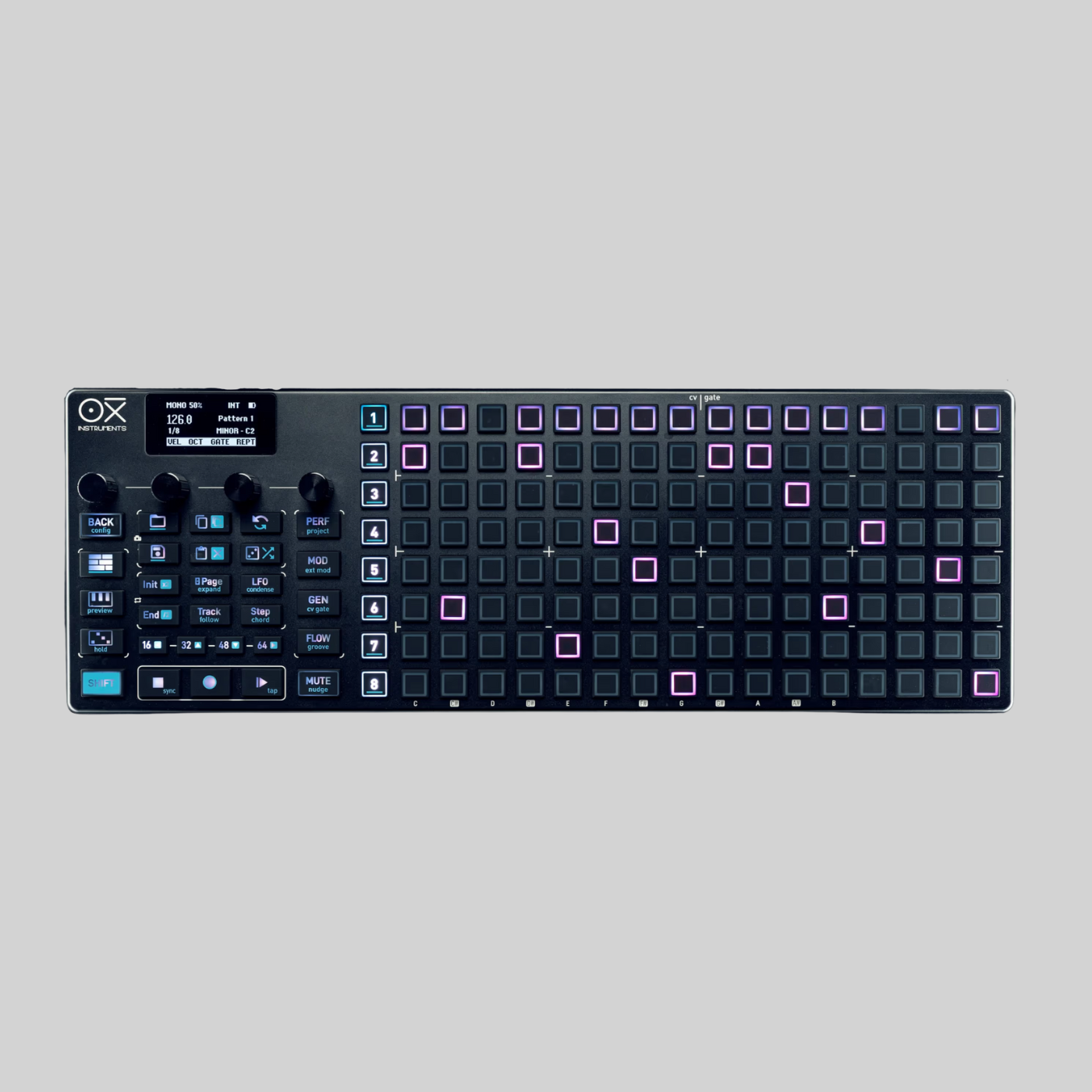
The OXI One MK2 absolutely floored me with its depth and versatility. Recently unveiled at Superbooth 2025, this updated version of their flagship sequencer takes everything to another level with eight independent sequencer tracks (doubled from the original) and up to 64 total tracks with 128 steps each.
What impressed me most was the modulation capabilities - eight modulation lanes per sequencer for a total of 64 possible modulation paths, plus 16 LFOs across the system. This kind of deep modulation potential is perfect for the hypnotic techno textures I'm always chasing.
The OXI One MK2 also features innovative Accumulator and Repeat engines with enhanced logic conditions, making it possible to create intricate, evolving rhythmic patterns. The side-chaining capabilities are next-level, letting you create dynamic relationships between different elements of your track.
The physical design is sleek - full anodized aluminum with premium knobs and a bright OLED display. For connectivity, it offers 8 CV and 8 Gate outputs, fully configurable for modular integration, plus MIDI over USB, TRS, and even Bluetooth. At around €888 (approximately $950), it's certainly an investment, but the feature set matches the price point.
The Torso Electronics T-1
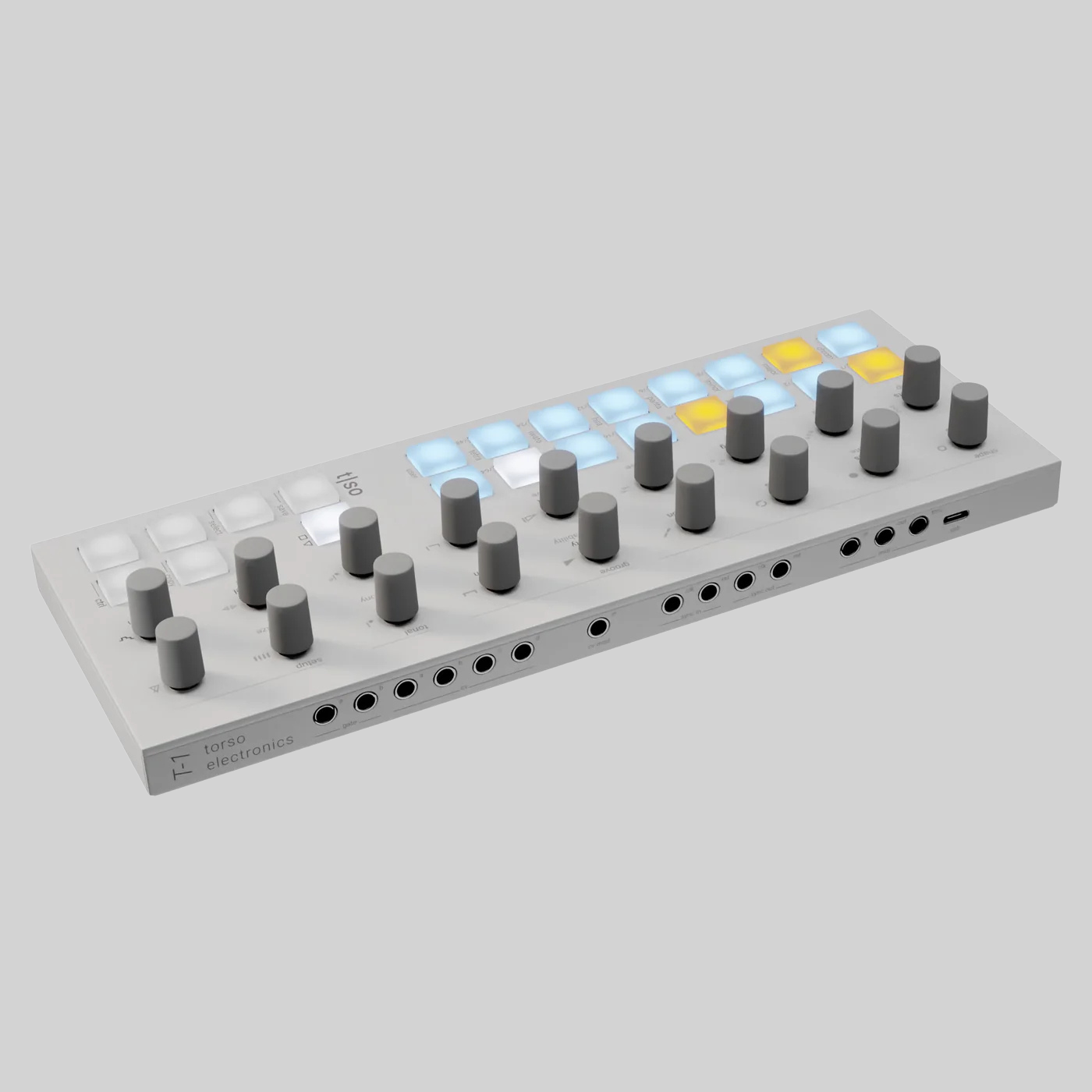
And then there was the Torso T-1 - an algorithmic sequencer using Euclidean rhythms that immediately resonated with me on a different level. While the OXI had screens and menus, the T-1 took a more minimal approach, focusing on knobs and direct control.
The T-1's approach to sequencing is fundamentally different - it's built around Euclidean rhythm generation, which automatically distributes pulses as evenly as possible across a sequence. This mathematical approach to rhythm creation produces naturally musical results, even when you're just experimenting.
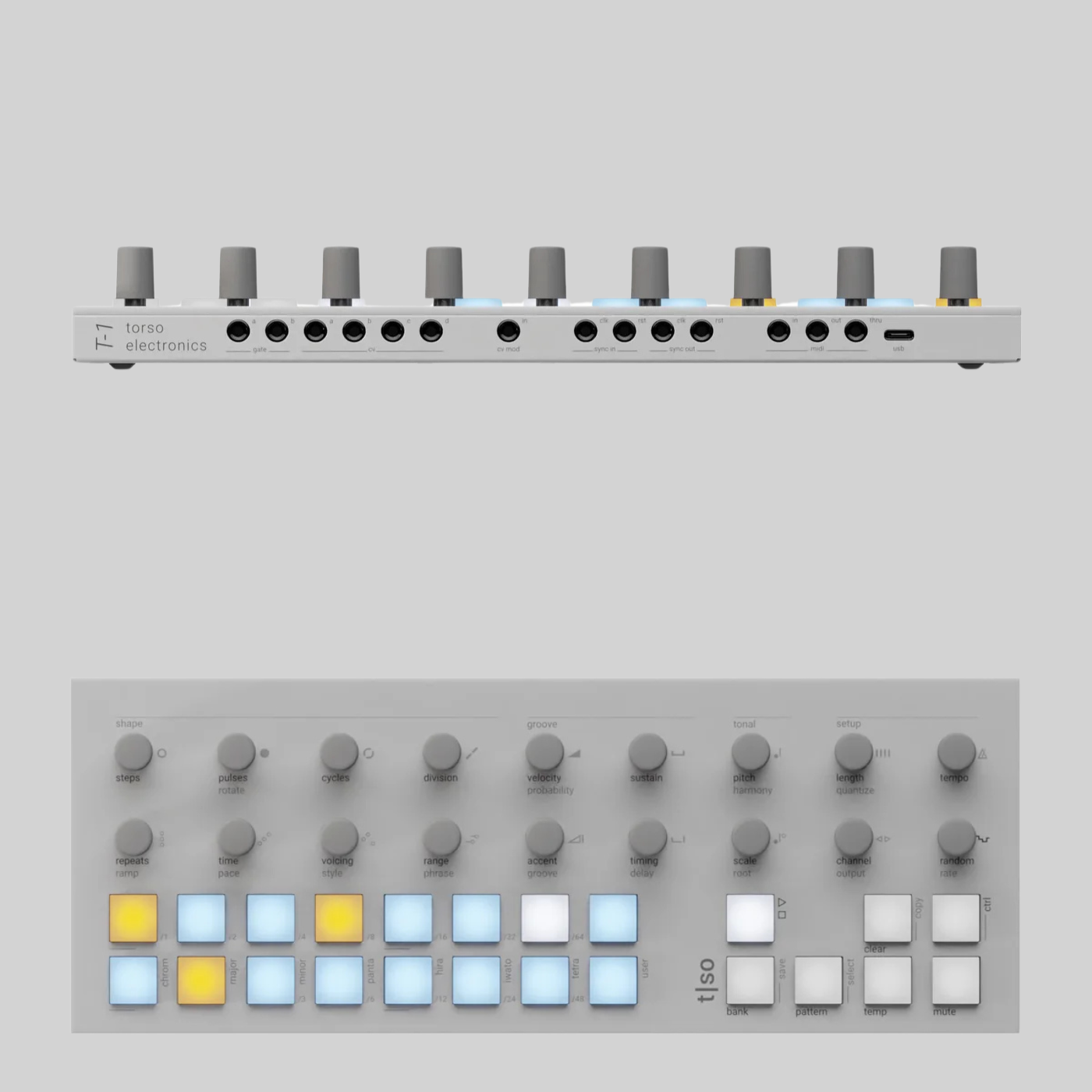
What makes the T-1 special is how it enhances this foundation with embedded velocity grooves, swing capabilities, and a sophisticated step editing feature that lets you manually tweak the algorithmically generated patterns. The device offers 16 polyphonic tracks per pattern, with 16 patterns per bank and a total of 16 banks.
The note repeater/arpeggiator function allows you to add repeats on top of Euclidean pulses and apply different voicing styles to build evolving patterns. For melodic control, the T-1 offers seven musical scales plus one user scale per track, with tools for harmonic pitch control.
Priced around €599, the T-1 comes in a compact matte black aluminum case with 18 endless rotary encoders and 23 multicolor keypad buttons. For connectivity, it offers USB-C, MIDI I/O/T, CV and gate I/O, and Ableton Link over WiFi.
The Decision Process
As I weighed my options, both technical and practical considerations came into play. The OXI One MK2 offered more raw power - more tracks, more modulation options, and arguably more visual feedback through its larger display. Its expanded chord mode with smart chord selection and enhanced performance mode were particularly compelling for live use.
Meanwhile, the T-1 offered a more focused, tactile approach. There was something about its workflow that felt musical from the first touch - less menu diving, more immediacy. The randomization capabilities, which can be added to every parameter on each track, struck a perfect balance between controlled variation and happy accidents.
Price was certainly a factor - the Torso T-1 is priced at $599 USD (approximately €550 EUR / £470 GBP) while the OXI One MK2 is available in two versions: the Nostalgia Edition at €877 ($943 USD / £730 GBP) and the Black Edition at €888 ($955 USD / £740 GBP). Despite the T-1 being significantly less expensive than I initially thought, both sequencers still represent substantial investments for a single piece of gear. The T-1 was also more compact and portable, which matters when you're hauling gear to gigs across events.
But what ultimately swayed me toward the T-1 was experiencing it in action during a live set by Surgeon. Using just the 1010 Music Delay, an S4, and the T1, he delivered one of the most hypnotic, groovy live performances I've ever witnessed. It was a master class in doing more with less, and it showed exactly how powerful the T1 could be in the right hands.
The T-1's approach to sequencing aligned perfectly with how my brain works. The Euclidean rhythm generation felt like a natural extension of my musical thinking - mathematical yet intuitive, precise yet organic. While the OXI One MK2 is objectively more feature-rich, the T-1 felt like it was designed specifically for the way I approach electronic music.
The Unexpected: Ableton Move
I have to mention one surprise from the event - the Ableton Move. I'll be honest, I initially dismissed it as a beginner's toy. I couldn't have been more wrong.
During an impromptu rooftop session, I got my hands on one and discovered it's actually an incredibly powerful drum machine with four flexible channels and a built-in sequencer that's perfect for live acts. Lightweight, capable, and surprisingly intuitive - it wasn't what I came for, but it definitely earned my respect.
Equipment That Will Define
That's what makes Superbooth special. You might go for the gear, but you stay for the people and the experience. And sometimes, along the way, you find exactly the piece of equipment that will define your sound for years to come.
Next up
Integrating the T-1 into my existing setup and seeing just how far I can push those Euclidean rhythms. Stay tuned for that video - it's going to be a deep dive into mathematical sequencing and how it translates into the hypnotic soundscapes I've been chasing.
What was your Superbooth highlight this year? Drop a comment below - I'd love to know what gear spoke your language.