Every now and then a tool lands in my lap that pulls me straight back into the part of music I love most. Not the mixing, not the arranging, just sitting there with a weird recording and turning it into something alive. That happened again with a plugin from Jonas Eriksson, and I had to make a video about it. This is the one that reminded me why sound design is the best part of the job.
Who is building this
Jonas has history. Before this he worked on the official iPad and phone apps for the Moog series. So when he tells me he is building something, I pay attention. His first release, Tape Fiasco, was a free glitch and stutter engine. You run any audio through it and you get these cool rhythmic effects, scratches, stutters, the kind of motion that makes a static recording feel like it is breathing. If you have not grabbed the first one yet, it is free on his site and worth your time.
I filmed this while testing the Tape Fiasco 2 beta with him. Since then he has shipped it, so everything you see here is the real thing.
Not a plugin anymore, a full FX engine
This time it is different. It is not just a plugin. You get a full modular FX engine inside one window. To show you what I mean I loaded up a handful of field recordings I made over the years. One is some texture I captured sitting inside a tank. One is water dripping while I sat outside. Just world noise, raw material. I dropped Tape Fiasco 2 on them and the whole thing came to life.
The quality is genuinely crazy. I put a recording into texture mode, set the grain size and the flux, slowed the rate down, and got this slow scratching grain texture that I could happily sit inside for ten minutes. Then I chained it with some glitching and the source recording barely mattered anymore. It became its own instrument.
The engine is organized into a few modes. Time gives you the stutter and varispeed stretching that the first version was known for. FX is where you build a chain of effects, top to bottom, a bit like the good old Guitar Rig. You drop effects in, reorder them, mute them, delete them, all very visual. Animate is the modulation brain. Perform is an XY pad where you map anything you want for live playing.
The modulation matrix is the real magic
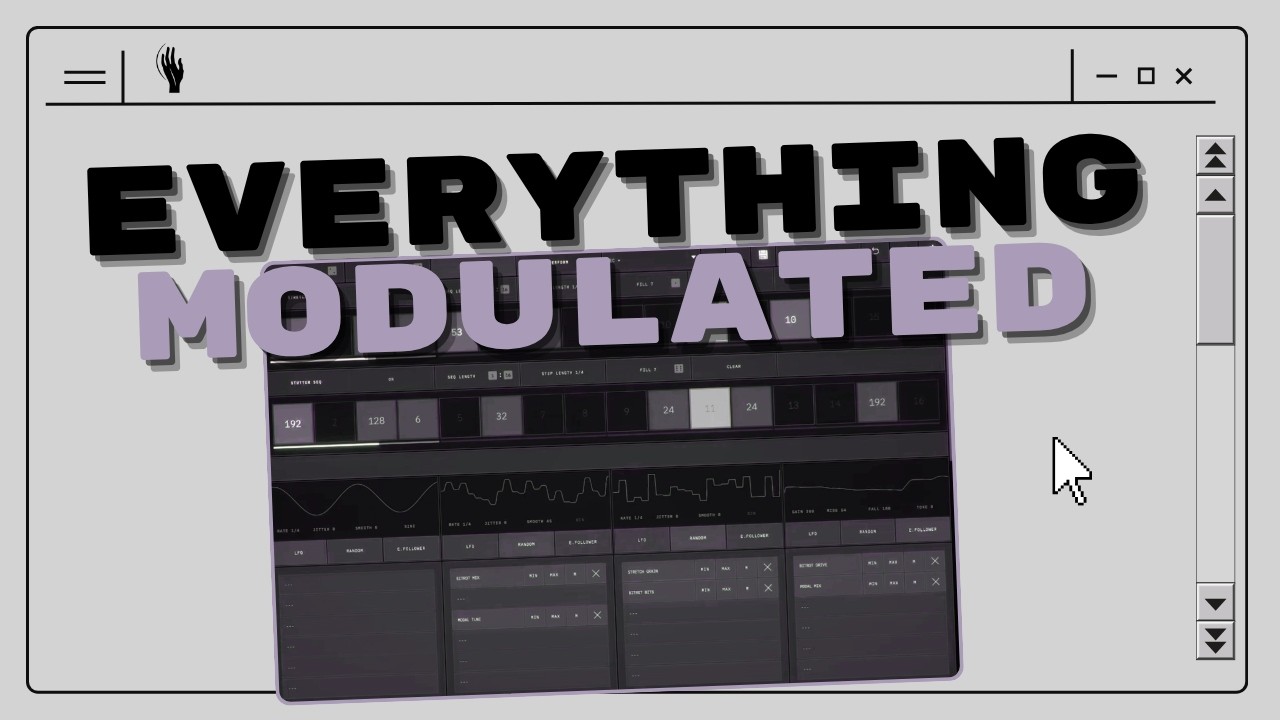
Here is what makes it sing. Almost everything can be modulated. There is a modulation matrix inside that is, honestly, insane. In Animate you get sequences, four engines you can map to a long list of destinations, and you can shape the modulation curves yourself. Envelope followers, random, LFOs, whatever you want, and if the built in shapes are not enough you draw your own. We are talking about actually animating a sound, not just adding movement.
The little details are what sell it for me. The grayed out controls show you what is already modulated, and you can pull the modulation off them right there. I touch a parameter and I get visual feedback. I do not need a label to tell me it is panning, I touch it, I hear it, I see the image, and I get it. That is the kind of design I love.
Why do the effects sound this good
When you grab a glitch or drum tool these days, you do not expect the reverb inside it to sound great, because that is not the point of the plugin. With Tape Fiasco 2 the effects library sounds so good that I kept asking myself how this is even possible.
So I texted Jonas about it, and the answer explained everything. He told me he felt like he was building a plugin that wanted to be too many things. Because what he is actually building is his own DAW, called Modular Fiasco. It even has a visual engine inside, so you can make your own visuals and chill to them. It is a node based DAW and a plugin at the same time, so you can run it inside Ableton if you want. Synths, drums, sampler, sequencer, and 35 effects. That is why the FX library punches so far above a normal stutter plugin. It was never built to be just a stutter plugin.
The design language is way more my type than something like VCV Rack. With modular I want my hands between the cables. Here I get the overview, everything in its corner, and I can move fast.
What to try next
Tape Fiasco 2 is out now. It runs as VST3 and AU on Windows and macOS for 29 dollars, and it packs four time engines you can chain in any order: granular stretch, tape varispeed, rhythmic stutter, and BendIt, a circuit bent buffer mangler with a DJ scratch mode. On top of that sit 21 effects you can reorder and modulate together, with a modulation system that can move up to 72 parameters at once.
My honest recommendation is to put this guy on your radar, because he is building something much bigger than a single plugin. If you want to try the idea for free first, grab the original Tape Fiasco, run your messiest field recordings through it, and see how fast a boring sound turns into something you want to build a whole track around. Then jump to the second one. You can find both, plus everything else he is building, over at Phase Fiasco. That is the feeling I am chasing, and this is the tool that brought it back.
If you are into finding tools like this, I love this kind of technology, so go check it out.
If you enjoyed this, check out I Don't Like VSTs But This One and Constant Moving Modulations with HydroSwarm.