Someone from our community built a real VST plugin and sent it over for honest feedback. So I sat down and used it. HydroSwarm is a motion-driven multi-effect by Swarm Audio DSP, made by Rati out of Georgia, and the whole idea is that nothing stays still. Filter, delay, shimmer reverb, EQ, all of it breathing on its own through LFOs. Exactly the kind of tool I reach for when I'm building ambient textures.
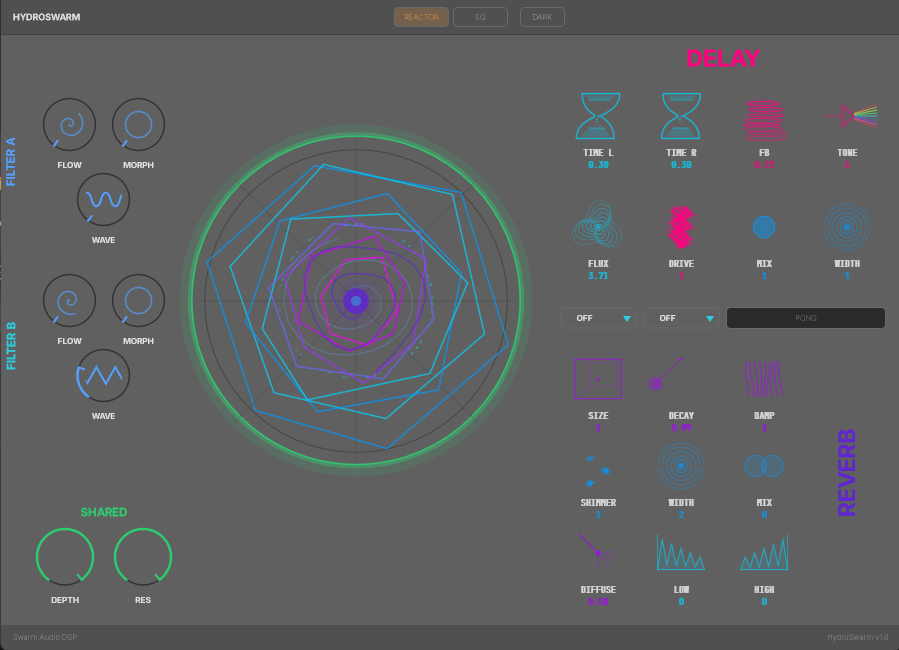
What HydroSwarm Is
HydroSwarm is a motion-driven multi-FX engine that chains four modules together: a dual morphing SVF filter, a varispeed flanger-delay, an algorithmic shimmer reverb, and an 8-band parametric EQ with per-band LFO modulation. In a nutshell, think flanger-bass-delay, shimmer reverb, two filters, and everything moves because of LFOs. All I need for ambient.
Swarm's philosophy is the part that sold me. Their tools don't produce static sounds or preset-driven workflows. They create environments where audio evolves naturally, systems that shift, breathe, and respond over time, inspired by hypnotic techno and psychoacoustic perception. Every parameter generates intelligent movement rather than sitting at a fixed state. That mindset is exactly why this fits ambient and hypnotic work.
The Setup
I kept it simple. A sequencer in Ableton firing into an Operator rack, just some pings, nothing fancy, all running through HydroSwarm. The plan was to see how much sound design I could pull out of this thing live, without touching presets. I'd never opened it before, so this was a genuine first-impression exploration.
From there I built a full atmosphere from scratch, then later pushed a granulated [[field recording]] (a recording off the Autobahn bridge) through it, sat it far back in the reverb, and let everything play together. HydroSwarm everywhere except the dry recording.
What Works
The engine itself is solid. The reverb sounds beautiful, long decays open up huge, and the delay can get rhythmic when you sync it or go wild when you push the feedback like an oscillator. This is where the plugin shines.
The clever part is the per-band modulated EQ. You set how much gain difference you want and the EQ moves itself. The modulation lives inside the device instead of needing you to map it. That's a fresh way to think about building a tool, and honestly it got me thinking about my own sequencer project and how to bake character into a device rather than leaving everything to manual modulation.
I also love that it niches down. This isn't trying to be every plugin. It's built for one kind of music and it owns that. After years of running only [[stock devices]], it's cool to see this open modding scene for producers come back to life.
The One Critique
The filter section doesn't clearly show where it's mapped or which frequencies I'm cutting. It gives nice visual feedback on the movement, but I want a real filter curve and some measurement so I know what I'm actually doing. A lot of UI space feels lost without it. The EQ section gets this right, the filters don't yet. That's my honest producer feedback: it sounds great, it just needs a little more to see and play with.
Timestamps
- 0:00 - Intro: new simple webcam workflow
- 0:42 - How Rati and Swarm Audio DSP got in touch
- 2:03 - What HydroSwarm actually is
- 2:47 - The Ableton setup: sequencer into the Operator rack
- 5:00 - First exploration: Flow, Morph and the delay
- 9:48 - Pushing feedback like an oscillator
- 10:56 - Adding a granulated field recording
- 17:53 - The per-band modulated EQ
- 25:24 - Final verdict and the one critique
Get HydroSwarm
If you want to try it yourself, here's the link to grab it: HydroSwarm by Swarm Audio DSP. Use the code MORDIO30 at checkout for a discount. Supporting builders from the community directly is the whole point.
If you enjoyed this, check out I Don't Like VSTs But This One… and Slink Filter VST for more on plugins that actually earned a place in my setup, or The Liquid Modulation Matrix for more on living, modulated sound.